Table of Contents
1. Intro to Artificial Intelligence
1.1 Intro to AI
1.2 Milestones in AI
1.3 Foundations of AI
1.4 Machine learning
1.5 Computer vision
1.6 Natural language processing
1.7 Robotics
1.8 Generative AI
1.9 Future of AI
2. Large Language Models
2.1 Language models
2.2 Text processing
2.3 Large language models
2.4 Using LLMs
2.5 Fine-tuning LLMs
2.6 Retrieval-augmented generation
3. Prompt Engineering
3.1 Prompts
3.2 Effective prompts
3.3 Role-based prompting
3.4 Iterative prompting
3.5 Chain of thought prompting
3.6 Evaluating prompts
3.7 Evaluating outputs
4. Hallucinations
4.1 Hallucinations
4.2 Types of hallucinations
4.3 Identifying hallucinations
4.4 Reducing hallucinations
4.5 Misinformation
4.6 Long-term effects of hallucinations
5. Agentic AI
5.1 AI agents
5.2 Types of AI agents
5.3 Agent workflows and components
5.4 Tool calling
5.5 Agent collaboration
5.6 Limitations and risks
6. Bias and fairness
6.1 Bias
6.2 Sources of bias
6.3 Implicit vs. explicit bias
6.4 Impact of bias
6.5 Addressing bias
6.6 Fairness
6.7 Transparency
6.8 Explainability
7. Applications of AI
7.1Everyday applications
7.2 Healthcare
7.3 Law and government
7.4 Arts
7.5 Business and finance
7.6 Science and research
7.7 Software development
7.8 Cybersecurity
More content and updates coming March 2027!
- Generative AI
- Regulations and frameworks
- Responsible AI use
- Working with AI
- Learning with AI
AI in the Classroom
Stay informed with our comprehensive AI in education resources and expert insights.
Building AI Literacy: Empowering Students to Explore and Apply AI Tools
zyBooks has taken a responsible approach that includes content and tools. See how we are empowering students and instructors with content and tools.
Foundational AI concepts for all
This title is intended for general education AI literacy courses.
- Establish a strong foundation for using AI tools in the classroom and in professional settings
- Develop a basic understanding of how AI tools work
- Learn how to use tools both effectively and ethically
- Applicable to all disciplines
- Customize to your course
Students from all disciplines will access conceptual overviews of how large language models (LLMs), generative AI, and agentic AI systems work, along with an introduction to prompt engineering and techniques for evaluating and reducing hallucinations. Students will learn about ethical issues like bias and fairness, how AI is used in industries and everyday life, and how to use AI responsibly in the workforce and the classroom.
Looking for AI with Python coding? Check out our Artificial Intelligence zyBook with zyLabs
What is a zyBook?
AI Essentials is an interactive learning solution that helps students visualize concepts, enabling them to learn more effectively than with a traditional textbook. Check out our research.
zyBooks utilize the “Say, Show, Ask” approach
Say. Use concise text as a jumping-off point to animations and learning questions.
Show. Animations help students visualize key concepts by replacing large amounts of text.
Ask. Learning questions and auto-graded homework problems encourage more student participation.
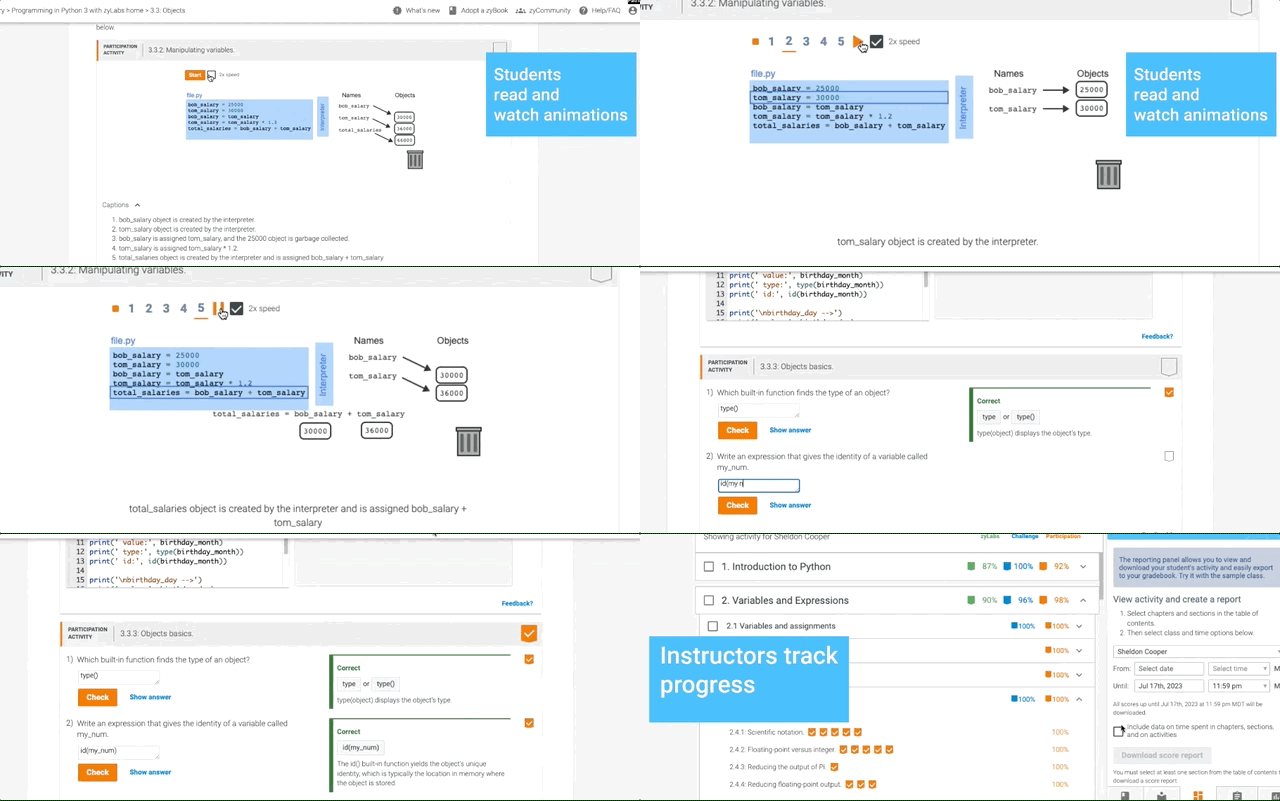
zyBooks benefits students and instructors:
- Instructor benefits
- Customize your course by reorganizing existing content, or adding your own
- Continuous publication model updates your course with the latest content and technologies
- Gain insight into students’ progress, reading and participation with robust reporting
- Save time with auto-graded challenge activities that seamlessly integrate with your LMS
- Build quizzes and exams
- Student benefits
- Learning questions and other content serve as an interactive form of reading
- Instant feedback homework
- Concepts come to life through extensive animations embedded into the interactive content
- Save chapters as PDFs to reference the material at any time
- More frequent, lower stakes assessments
Authors and contributors
Chinny Emeka
Content Author, Artificial Intelligence / PhD in Computer Science, University of Illinois at Urbana-Champaign
Pamela Fellers
Content Author, Data Science and Statistics / PhD in Statistics, University of Nebraska–Lincoln
Zoe Fox
Associate Content Author, Data Science and Statistics / BS in Mathematics and Statistics, University of British Columbia
Kate Nichols
Content Author, Computer Science / BA in Education, The University of Texas at Austin
Aimee Schwab-McCoy
Senior Manager, Content Development, Data Science, Mathematics and Statistics / PhD in Statistics, University of Nebraska–Lincoln
Dianna Spence
Content Author, Data Science and Statistics / PhD in Mathematics Education, Emory University
Check out these related zyBooks