Academic Integrity · Last Updated July 2026

zyBooks strengthens academic integrity across your CS course with five built-in tools

Last updated July 2026  ·  Jump to FAQ

Does zyBooks have academic integrity tools?
Yes. zyBooks includes five academic integrity features built directly into its coding labs (zyLabs): Code Playback, a Similarity Checker powered by MOSS, Paste Limiting, Student Behavior Insights, and a randomized Assessments platform with lockdown browser support. These tools work alongside zyBooks’ pedagogical design of frequent, low-stakes assignments spread throughout the reading, and research shows this in itself is one of the most effective structural deterrents to cheating.

Five Tools, One Platform

A full suite of academic integrity tools

Each tool targets a different moment in the academic integrity lifecycle: before, during, and after an assignment.

Detect

Student Behavior Insights: spot outliers before grades are posted
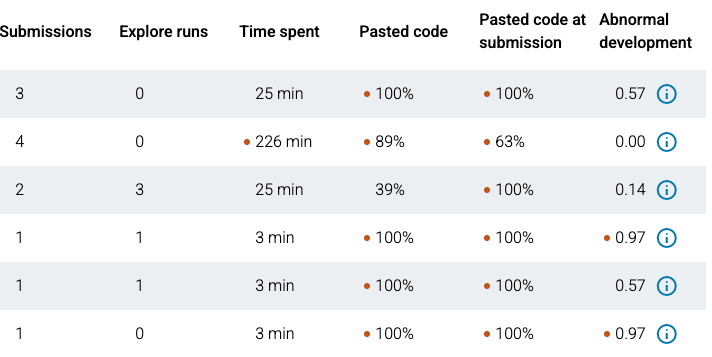
zyBooks Student Behavior Insights dashboard showing class-level averages for time on task, paste activity, and submission count, with outlier students flagged automatically

The Student Behavior Insights dashboard shows class-level averages for time spent, paste activity, and submission count on any assignment. Students who fall significantly outside those averages are flagged automatically, giving you a starting point for review. It’s especially valuable as AI tools make traditional integrity measures harder to rely on.

  • Track class-level averages for time-on-task, paste events, and submission attempts.
  • Automatically flags outliers by time, pasted code volume, and submission count.
  • Drill into any flagged student to view their Code Playback directly.
  • Identify struggling students who are working earnestly, not just potential academic integrity cases.
See Student Behavior Insights
Detect

Code Playback: see the work, not just the result
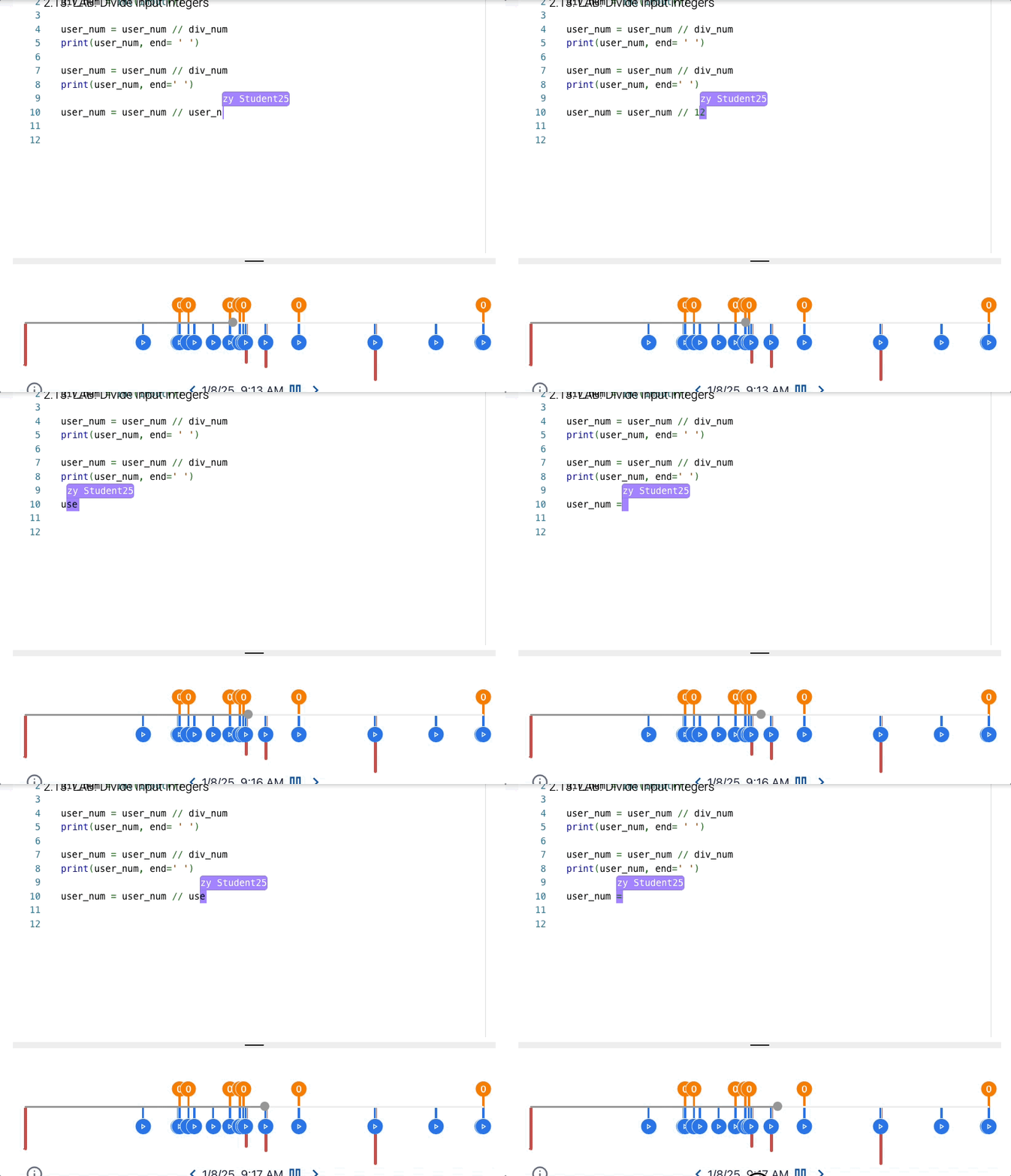
zyBooks Code Playback replaying a student's zyLab submission keystroke by keystroke, highlighting a large paste event

Code Playback lets you replay exactly how the student wrote their program, keystroke by keystroke. You can see where they paused, where they struggled, and when large blocks of code appeared in a single paste event. In the era of AI, how students arrive at answers is just as important as the answers themselves.

  • Replay any zyLabs submission keystroke by keystroke.
  • Paste events are flagged and timestamped so you can jump straight to them.
  • Reveals whether a student worked incrementally or pasted a complete solution.
  • Identify where struggling students are getting off track, not just where misconduct may have occurred.
See Code Playback
Deter

Paste Limiting: raise the barrier without raising the stakes
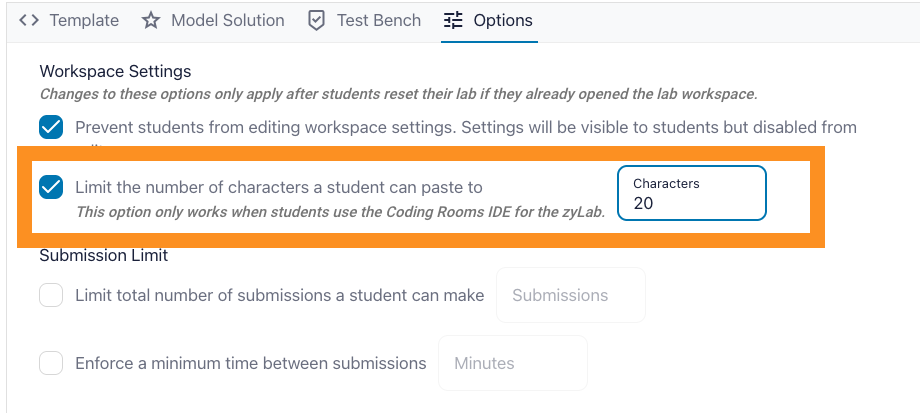
zyBooks Paste Limiting setting showing a character limit slider set to 50 characters per paste event in a zyLab assignment

Paste Limiting lets you restrict how much code a student can paste into any zyLab. You set the character limit per assignment. It allows normal workflow (copying a function signature, pasting a variable name) while making it impractical to drop in a full solution from an AI tool or a classmate.

  • Enabled per assignment; you decide which labs need it.
  • You set the character limit: strict for exams, relaxed for practice labs.
  • Students still write freely; the constraint targets bulk copy-paste specifically.
See Paste Limiting
Detect

Similarity Checker: find matching submissions automatically
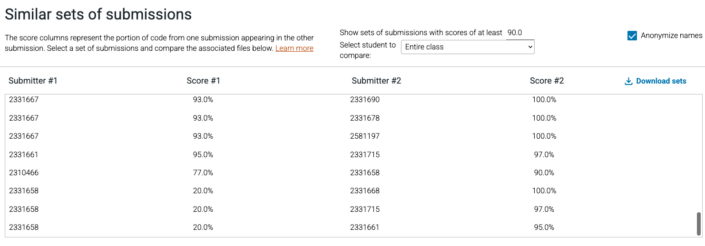
zyBooks Similarity Checker report showing flagged submission pairs with similarity percentages, powered by MOSS

After every assignment deadline, zyBooks runs your class submissions through MOSS, the industry-standard code similarity detection system used by universities worldwide. The integrated report shows you which pairs are similar and by how much, so nothing slips through.

  • Automatically runs across all submissions in your class after each deadline.
  • Powered by MOSS (Measure of Software Similarity), the standard used by Stanford and institutions worldwide.
  • Similarity scores are integrated directly into your zyLabs report with no export needed.
  • Identifies structural similarity, not just copy-paste, catching rewrites too.
See Similarity Checker
New · Assessments Platform

Assessments with randomized questions and lockdown browser support

A CS instructor reviewing a locked zyBooks assessment with lockdown browser support and randomized questions

zyBooks’ Assessments Platform works with lockdown browsers to prevent tab-switching, screen capture, and access to other applications during an exam. And because every student sees a different question variant drawn from a pooled bank, sharing answers yields little advantage.

  • Compatible with lockdown browsers, blocking tab-switching, screen capture, and app access during exams.
  • Question pooling draws from a large bank; same topic, different question for each student.
  • Highly randomized Challenge Activities mean screenshots of questions are rarely reusable.
  • Access controls let you set time windows, attempt limits, and password protection per assessment.
  • Auto-graded zyLabs can be embedded directly within a locked assessment.
View the assessments guide

Teaching Strategy

zyBooks’ tools detect possible academic dishonesty. These teaching strategies help to prevent it.

Use course design to make cheating less appealing, not just harder to commit. zyBooks’ research-backed cheating prevention guide walks you through the strategies that work, with practical examples for CS courses.

Read the cheating prevention guide

FAQ

Academic integrity questions instructors ask about zyBooks

These are the questions CS faculty ask us about academic integrity before adopting zyBooks.

Does zyBooks detect cheating?+
zyBooks provides tools that help instructors identify potential academic dishonesty; it does not make that determination itself. The Similarity Checker flags pairs of submissions with similar code, Code Playback lets you review how a submission was built keystroke by keystroke, and Student Behavior Insights surfaces outliers across the class. Together, these give instructors the evidence they need to investigate and act, but the judgment call remains with the instructor.
How does zyBooks’ Code Playback work?+
Code Playback records every keystroke a student makes in a zyLab and lets instructors replay it like a video. You can scrub through the timeline, see exactly when code was typed versus pasted, and view the size and timing of each paste event. This makes it straightforward to distinguish between a student who worked incrementally (even if imperfectly) and one who typed a few lines and pasted in a completed solution.
What is the Similarity Checker and how does it detect similar code?+
zyBooks’ Similarity Checker uses MOSS (Measure of Software Similarity), a well-established code comparison system originally developed at Stanford. After each assignment deadline, MOSS automatically compares all submissions in your class and identifies pairs with structurally similar code. Unlike simple text comparison, MOSS detects similarity even when variable names have been changed or code has been rearranged. Results appear directly in your zyLabs report with similarity percentages for each flagged pair.
Can zyBooks prevent students from using ChatGPT or other AI tools?+
zyBooks cannot block external AI tools outright, but it gives you several ways to limit their impact. For assessed work, the Assessments Platform works with lockdown browsers, Honorlock and Respondus among them, which block access to external websites, applications, and AI tools during an exam. For coding labs, AI Hints gives students in-platform, Socratic guidance when they are stuck, reducing the incentive to reach for ChatGPT. Paste Limiting makes it harder to drop in AI-generated code wholesale. Student Behavior Insights and Code Playback make it straightforward to identify submissions where very little actual coding took place. Instructors who combine these tools with a clear AI policy set at the start of term report the most consistent results.
Does the Assessments Platform work with lockdown browsers?+
Yes. zyBooks’ Assessments Platform is compatible with lockdown browsers, which prevent students from switching tabs, taking screenshots, or accessing other applications during an exam. Combined with question pooling and highly randomized activity variants, so each student sees a different version, this significantly reduces the value of coordinating answers in real time.
How does Paste Limiting work, and which labs should I enable it for?+
Paste Limiting lets you set a maximum character count for any single paste event in a zyLab. You control the limit and choose which labs have it enabled. Most instructors set a lower limit for graded assignments (around 50 characters) and a higher or no limit for practice labs. The limit blocks large copy-paste actions with a notification to the student; it does not restrict how much code they can write. Code Playback records all activity regardless of whether paste limiting is on, so you can always review the full submission history.
Can students see solutions after completing the assessment?+
This is controlled by instructor permissions. You can choose to show students just their score, their score plus their own submission for each question, or their score plus submissions plus the correct solutions. This setting can be changed at any time, including after students have already taken the exam.
How does zyBooks handle exam security? Does it work with lockdown browsers?+
Yes. zyBooks Assessments work with common lockdown browsers, including Honorlock and Respondus. Safe Exam Browser and Lockdown Browser are also supported and are free to use even if your institution does not have an official affiliation with them. Before your assessment, refer to the zyBooks Support help site for the URLs you will need to whitelist within your lockdown browser.

See zyBooks’ academic integrity tools in action

Request a demo to see Student Behavior Insights, Code Playback, and the other tools, or request an evaluation copy to explore any zyBook yourself.