Table of Contents
1. Introduction to Database Design
1.1 Database basics
1.2 Database systems
1.3 Operational and analytic databases
1.4 Database design process
1.5 Database design tools
2. Relational Databases
2.1 Tables
2.2 Data types
2.3 Selecting rows
2.4 Null values
2.5 Inserting, updating, and deleting
2.6 Primary keys
2.7 Foreign keys
2.8 Referential integrity
2.9 Constraints
2.10 Join Queries
2.11 View tables
2.12 Procedural SQL
3. Conceptual Design
3.1 Conceptual design process
3.2 Entity-relationship model
3.3 Discovery
3.4 Cardinality
3.5 Business rules
3.6 Subject areas
4. Special Modeling Types
4.1 Strong and weak entities
4.2 Supertype and subtype entities
4.3 Partitions and hierarchies
4.4 Temporal entities
4.5 Complex relationships
4.6 Derived attributes
4.7 Alternative modeling conventions
5. Case Study: Conceptual Design
5.1 Case study: Discovery
5.2 Case study: Cardinality
5.3 Case study: Supertype and weak entities
5.4 Case study: Business rules and derived attributes
5.5 Case study: Temporal entities
6. Logical Design
6.1 Logical design process
6.2 Implementing entities
6.3 Implementing relationships
6.4 Implementing attributes
6.5 Implementing business rules
6.6 Implementing derived attributes
6.7 Dimensional design
7. Normal Form
7.1 Functional dependence
7.2 First, second, third normal form
7.3 Boyce-Codd normal form
7.4 Applying normal form
8. Case Study: Logical Design
8.1 Case study: Implementing entities
8.2 Case study: Implementing relationships
8.3 Case study: Implementing attributes
8.4 Case study: Implementing business rules and derived attributes
8.5 Case study: Dimensional design
8.6 Case study: Applying normal form
9. Physical Structures
9.1 Storage media
9.2 Table structures
9.3 Single-level indexes
9.4 Multi-level indexes
9.5 Other indexes
9.6 SQL for indexes
9.7 Tablespaces and partitions
10. Physical Design
10.1 Physical design process
10.2 Physical design and leading database systems
10.3 Sorting, orienting, and storing tables
10.4 Partitioning tables
10.5 Selecting indexes
11. Case Study: Physical Design
11.1 Case study: Structuring tables
11.2 Case study: Selecting indexes
Easily combines with Database Systems
Build content that meets course goals
Teach Databases with this interactive zyBook with customizable zyLabs
Database Design provides highly interactive content and tools for teaching database design and data modeling.
- Covers conceptual, logical, and physical design
- Three‑phase lab project with ER and table diagrams
- Detailed case studies illustrating user requirements capture, data modeling, and implementation.
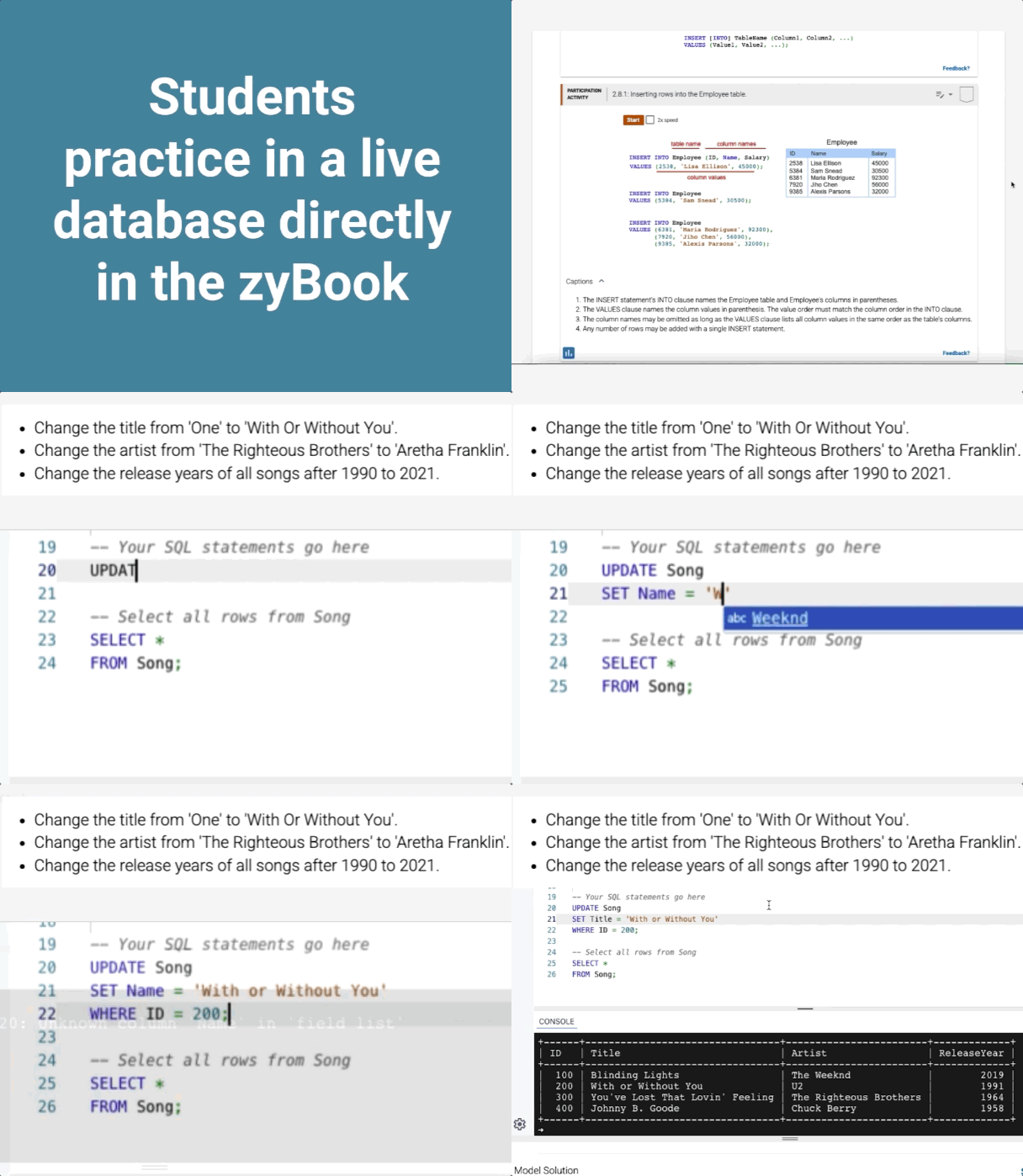
- Embedded IDE for writing and submitting SQL labs
- AI tools to assist with lab creation, assessments, and student hints
What is a zyBook?
Database Design is an interactive learning solution that helps students visualize concepts, enabling them to learn more effectively than with a traditional textbook. Check out our research.
- Instructor Benefits
- Customize your course by reorganizing existing content or adding your own
- Continuous publication model updates your course with the latest content and technologies
- Robust reporting gives you insight into students’ progress, reading and participation
- Save time with auto-graded labs and challenge activities that seamlessly integrate with your LMS gradebook
- Student Benefits
- Learning questions and other content serve as an interactive form of reading
- Instant feedback on labs and homework
- Concepts come to life through extensive animations embedded into the interactive content
- Save chapters as PDFs to reference the material at any time
Author Paul Winsberg shows the zyLabs interface
Author
Paul Winsberg
Professor of Computer Science, Berkeley City College
Contributor
Michael Goldwasser, PhD
Professor of Computer Science / Saint Louis University